For tonight
How to make up a bedtime story
You do not need a whole adventure ready before you begin. Choose one familiar place, one curious detail and one small thing to put right. The story can be as short as your evening needs.
By StoryClub · Practical storytelling ideas for parents
Start with three choices
Ask your child to choose a place and a companion: a garden and a mouse, perhaps, or a kitchen and a bear. Offer two options if an open question feels too big. You can make the choices yourself when your child would rather listen.
Then add something slightly out of place. A flowerpot is humming. A spoon has a ribbon tied around it. A little boat is waiting in a puddle. Keep the question small enough that you can answer it before the story ends.
Give the character one thing to do
A curious detail becomes a story when someone responds to it. The mouse wants to find who is humming; the bear wants to return the ribbon. Let the first attempt reveal a new clue rather than introducing a new villain or a second adventure.
Use this spoken scaffold: “They noticed ___. They tried ___. That helped them discover ___. Together, they ___. Back home, ___.” Treat it as a handrail, not a rule.
Try it: the flowerpot that hummed
At the end of the garden sat a flowerpot that hummed whenever the wind blew. A small mouse put an ear beside it. “Are you singing?” The pot hummed again.
The mouse looked underneath. No singer. Then a child noticed a dry leaf caught across the little hole in the bottom. The wind was playing it like a tiny instrument.
They moved the pot beside the garden bench, where they could hear its tune together. When the wind grew quiet, the child tucked the leaf inside so it would not blow away. The mouse went home with a song to remember.
You can stop there. Or ask your child what the song sounded like and let that be the last line. This original example leaves room for their idea without requiring them to solve a puzzle.
When you lose the thread
Repeat the last thing you know: “So there they were, beside the humming pot.” Then ask a concrete question: “Should they look inside or underneath?” A choice gives you your next sentence.
If the story is getting too large, bring back something from the beginning. The missing ribbon belongs on the little boat; the mysterious sound comes from the familiar tree. You are allowed to say, “That part is an adventure for another day.”
Adjust the invitation, not the child
For ages 3–4, try one repeated sound and one choice. For ages 5–6, invite a suggestion for what the character tries. For ages 7–8, ask why the first idea did not work and let them supply a different solution. These are optional starting points, not developmental expectations.
Some evenings your child will want to direct every turn. Other evenings they will want you to tell the whole thing. Either way, close with a familiar place or a small resolved detail. A story does not need a lesson, and it does not promise sleep.
A bedtime story template to copy or print
Fill the gaps aloud or on paper. A sentence for each line is enough; skip a line if your story doesn’t need it.
- Tonight, in [a place], [a character] noticed [one curious thing].
- They wanted to [one small thing to do].
- First, they tried [an idea], but [what happened].
- Then [a companion] noticed [a useful detail].
- Together, they [what they did differently].
- At last, [how the small problem was put right].
- Back in [a familiar place], they [one quiet final action].
No details are entered or saved here. Copy uses your clipboard; Print opens your device’s print dialog. We count button use, without collecting your story.
From the published StoryClub sample
A first jump becomes a story to keep
The starting moment is small: a child jumps into the pool from the side for the first time. The sample follows the warm stone under their feet, the rush of bubbles and their rabbit companion waiting at the edge.
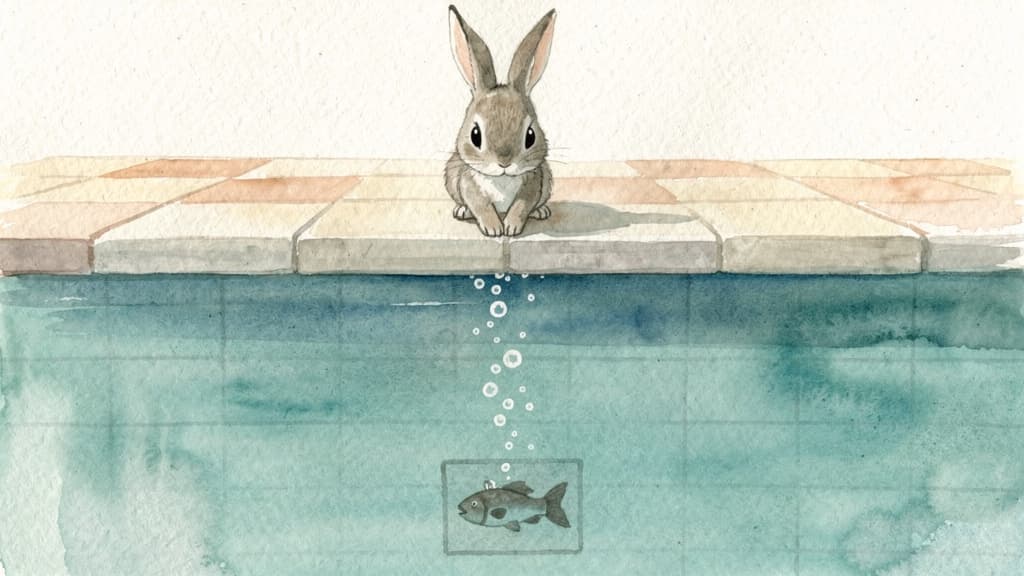
“That was the first time,” Bramble said. Amelie nodded. It had been.
A proud moment doesn’t need a big lesson at the end. Here it becomes an adventure with a quiet ending: a towel, warm sunshine and someone sitting close.
Read the illustrated sample →See how the personalised story app works →
The free starter gives you a beginning to tell together. StoryClub’s paid stories are personalised, illustrated books; reading this sample is free.